Maintaining the concrete surfaces around your property involves much more than preserving your home’s visual curb appeal. Addressing tiny fractures and minor surface scaling immediately serves as an essential defense mechanism against compounding structural damage that occurs beneath the visible surface.
Ignoring these seemingly harmless warning signs allows environmental elements to continuously attack the vulnerable internal matrix of the slab day after day. Taking a proactive approach to early preservation ensures that simple, low-cost maintenance issues do not rapidly spiral into completely unmanageable financial burdens.
The Exponential Escalation of Water Penetration
When a hairline crack forms on your driveway or walkway, it creates an open highway for rainwater and melting snow to seep deep into the core of the material. This moisture does not simply sit idle; it actively breaks down the internal chemical bonds that give the slab its foundational strength.
- Seal minor hairline fractures immediately using high-grade elastomeric fillers to lock out seasonal rain and humidity.
- Recognize that water pooling beneath the surface expands by approximately nine percent whenever temperatures drop below freezing.
- Monitor your surfaces for progressive spiderweb cracking patterns, which indicate that moisture is already spreading horizontally through the slab.
Leaving these small entry points unsealed guarantees that the localized moisture intrusion will eventually shatter the surrounding material from the inside out.
Subgrade Erosion and the Loss of Structural Support
A solid concrete slab relies entirely on the compacted gravel and soil base beneath it to evenly distribute heavy vehicular and pedestrian weight. When water bypasses the surface through unaddressed cracks, it washes away that crucial underlying dirt, leaving behind hidden, hollow air pockets.
- Fill deep structural joints early to prevent fast-moving stormwater from channeling underneath your paved zones.
- Watch for localized sinking or pitching along the edges of your walkways, which signals active subgrade erosion.
- Inject stabilizing lifting foams into early voids before the unbacked pavement collapses entirely under its own weight.
Failing to maintain a solid foundation underneath the heavy material inevitably causes the unsupported concrete to snap cleanly under everyday weight loads.
Rusting Reinforcement and Internal Structural Blowouts
Most residential slabs contain internal steel rebar or wire mesh grids designed to hold the heavy mixture together under intense physical tension. Once water and oxygen penetrate the protective barrier, the encapsulated metal begins to oxidize and corrode rapidly.
- Patch deep pits and spalled surfaces before the ambient air can interact with the hidden steel reinforcement skeleton.
- Understand that rusting iron expands up to six times its original volume, creating intense internal pressure.
- Address dark, rust-colored stains bleeding up through surface fractures, as this confirms advanced internal metal deterioration.
Allowing the internal steel structure to rust out completely destroys the tensile strength of the slab, rendering it entirely unsalvageable.
The Financial Realities of Full Demolition and Disposal
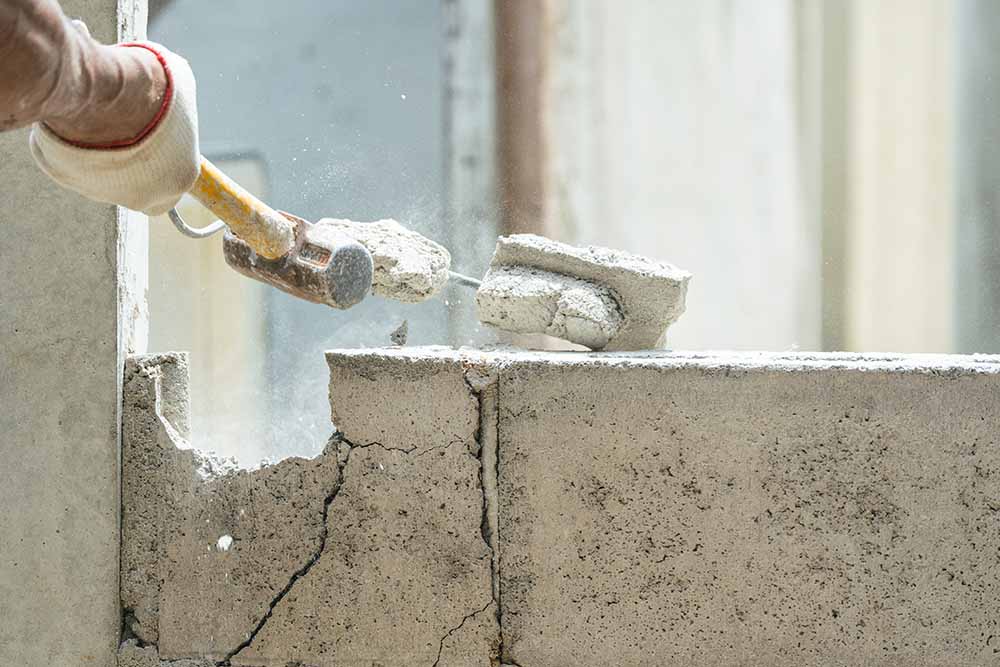
Opting to delay a minor repair job that costs a few hundred dollars eventually forces you to confront the astronomical realities of a total structural replacement. Full demolition requires heavy industrial machinery, extensive labor crews, and steep municipal landfill disposal fees that quickly add up to thousands of dollars.
- Contrast the minor cost of a topical sealant application against the massive price tag of a complete heavy machinery excavation.
- Factor in the inevitable damage that heavy jackhammers and skid steers will inflict on your surrounding landscape during demolition.
- Recognize that hauling away tons of broken structural debris carries independent environmental and trucking surcharges.
Investing a small amount of money into early preventative maintenance eliminates the unnecessary expense of tearing out an entire installation.
Ruined Curb Appeal and Depreciating Property Values
Beyond the immediate structural hazards, cracked and crumbling pavement severely detracts from the marketability and financial value of your entire property. Prospective home buyers and professional real estate appraisers view widespread concrete neglect as a clear indicator of deeper, systemic home maintenance issues.
- Maintain clean, uniform walkways to keep your property looking inviting and structurally secure from the street view.
- Prevent trip-and-fall liabilities on your property line by keeping all walking zones perfectly level and smooth.
- Maximize your eventual resale potential by showing buyers that minor wear was handled promptly with proper maintenance.
Keeping your hardscape in pristine condition preserves your hard-earned equity while ensuring your home remains a safe and beautiful environment.
Securing Your Investment Through Proactive Preservation
Taking immediate action against minor surface imperfections completely changes the long-term financial trajectory of your home maintenance budget. This simple commitment to early intervention entirely eliminates the physical decay, foundational erosion, and internal rust that trigger total system collapses.
Do not allow minor hairline fractures to silently mature into catastrophic, budget-breaking replacement projects over the next few seasons. Prioritizing timely, routine concrete maintenance ensures your outdoor surfaces remain beautiful, safe, and completely structurally sound for a lifetime.